
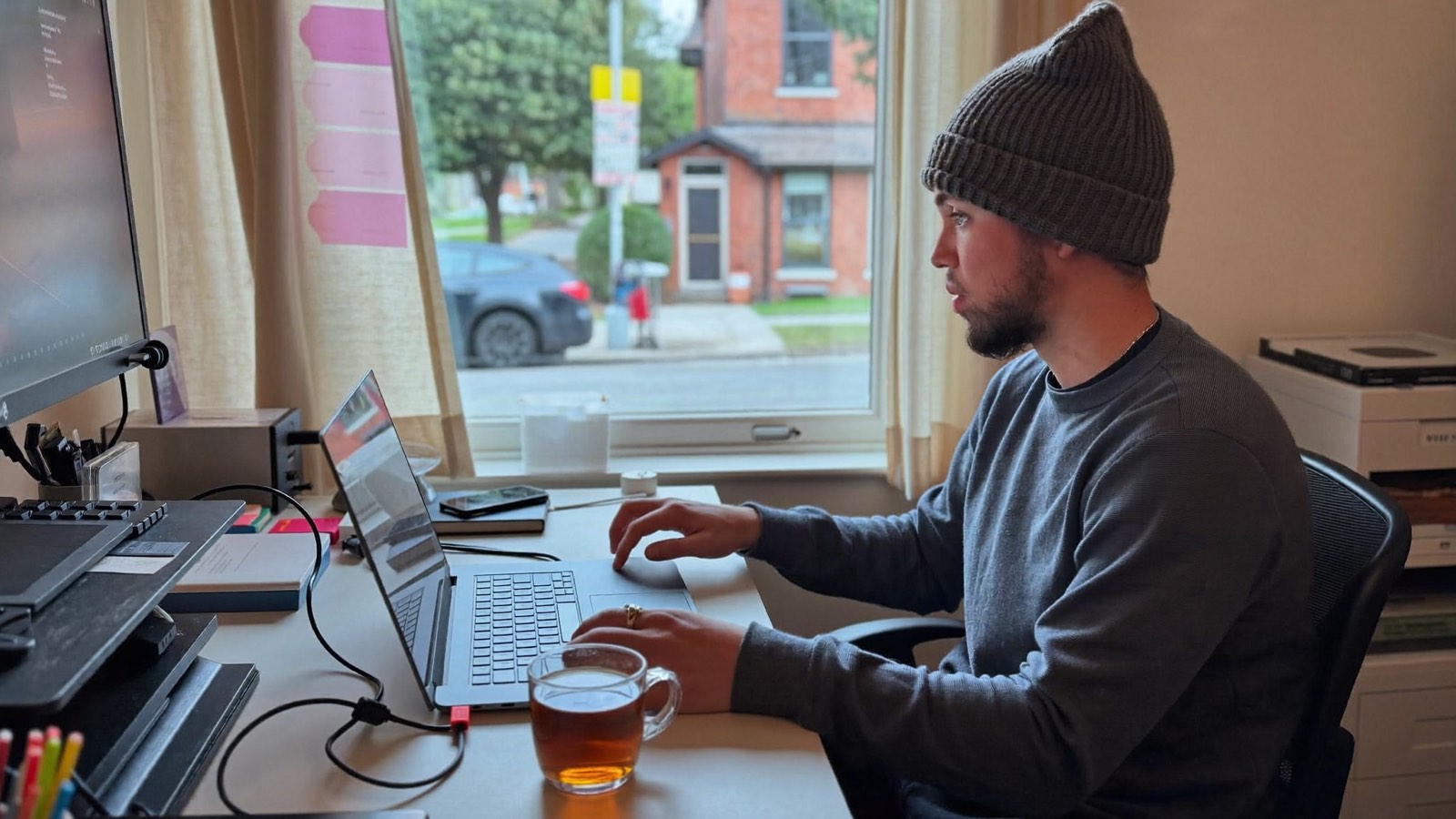
Working from home after a hair transplant is one of the gentlest ways to get through the first week, because you control the room, the schedule and who sees you. You still have a fresh scalp to protect, though, and a home office holds more small hazards than most people expect: an over-ear headset, a low kitchen cabinet, a dog that likes to jump up. Our hair transplant recovery guide covers the medical side of healing from the first day to the final result. This post stays at your desk. It walks through how to set up your workspace before surgery, what a webcam is likely to show each day, how to plan meetings and breaks, and when a quick call to the clinic makes sense.
If you are still deciding how many days to take off, or your job is not mostly remote, our guide on how soon you can go back to work compares typical return dates by job type. Here, we assume you already know you will be logging in from home and want week one to run smoothly.
Why Home Works Well in Week One
Most of what slows people down in the first days after FUE is not pain. It is the small stuff: a tender scalp, some swelling, a little tiredness and the need to keep anything from rubbing or bumping the grafts. A home office happens to remove many of those worries at once. There is no commute, no crowded train, no dress code and no colleague leaning over your shoulder. You can sit with your head upright all day, take a short rest when you need one and keep the room cool enough that you are not sweating.
Home also gives you choices about visibility. In an office, people see the top of your head whether you like it or not. On a video call, you decide the frame, the light and whether the camera is on at all. That flexibility is why many remote workers find they can stay productive while the scalp settles, as long as they plan a little ahead.
The catch is that home feels so familiar that it is easy to forget you are recovering. People who would never lift a heavy box at work will happily carry a full laundry basket upstairs, reach into a tight cupboard or let a toddler climb onto their lap. Treat the first week as a light-duty week, even if your laptop says business as usual.
Set Up Your Desk Before Surgery Day
The easiest time to sort out your workspace is the weekend before your procedure, while your scalp is still something you never have to think about. A few changes now save a lot of awkward reaching and stooping later.
Raise the screen and keep your head level
Prop your laptop on a stand or a short stack of books so the top of the screen sits near eye level, then use a separate keyboard and mouse. That keeps you looking forward rather than down, which tends to feel more comfortable while there is swelling across the forehead. It also helps your webcam, which we come back to below.
Check what sits at head height
Look around the desk for shelves, hanging lamps, plant hooks or open cabinet doors close to where your head moves when you stand up or lean back. Move them, or move the desk. A chair with a tall headrest is fine for the donor area at the back, but if your crown was treated, avoid resting your head against it for long stretches.
Put everything within arm's reach
Set out a water bottle, chargers, tissues, a few snacks, your care sheet and any prescribed items before the day. The fewer times you have to crouch under the desk for a cable or dig in a low drawer, the better. If something drops to the floor, bend at the knees and keep your head up rather than folding forward.
Keep the room cool and clean
A heater blowing across your desk and a stuffy room both make it easier to sweat. A fan pointed away from your head, an open window or a lower thermostat setting keeps things comfortable. Give the desk a dust before surgery as well, so you are not vacuuming or shaking out rugs during the first week.
Headsets, Hoods and Anything That Touches Your Head
This is the part most remote workers miss. A standard over-ear headset has a band that runs straight across the top of the scalp, which is exactly where most grafts sit. Our recovery instructions ask patients to avoid headbands, fitted caps and helmets for three weeks, and a headset band presses in a similar way. Swap it for earbuds or a single in-ear piece for the first few weeks, or use the laptop speaker and microphone with the door closed. A neckband style that sits behind the neck is another option.
Think about clothing too. Hoodies and tight sweaters get pulled over the head several times a day without a second thought. Button-up shirts, zip tops and loose cardigans avoid that, and they look just as tidy on camera. Glasses are fine, though it helps to lift them on and off with both hands rather than sliding them up over your hairline.
Indoors, most patients are simply told to leave the scalp uncovered so it can stay clean and dry. If you would like a loose, soft covering for a delivery at the door or a quick walk outside, check your care sheet first. Our team usually suggests a roomy, breathable cap once the second week arrives, put on and taken off gently, and never anything with a snug band across the treated area.
The same goes for anything else that could catch or rub. Reading lamps on a flexible arm, the edge of an open laptop lid when you lean in close and the sharp corner of a wall shelf all end up closer to your head than you would think. A quick walk around the room before the day, standing up and sitting down a few times, is enough to spot most of them.
What Your Webcam Might Show, Day by Day
Every scalp heals at its own pace, and the size and location of your procedure make a difference. The table below shows a common pattern for the first two weeks and simple ways to handle each stage on video. Use it as a rough guide, not a promise.
| Days after surgery | What may show on camera | An easy workaround |
| Days 1 to 2 | Redness on the treated area, a little tiredness | Camera off or out-of-office; rest comes first |
| Days 3 to 5 | Swelling that can drift down to the forehead and around the eyes | Audio calls, or a slightly higher camera angle |
| Days 5 to 7 | Small crusts across the recipient area | Frame the shot at the brow line; soft side light |
| Days 7 to 10 | Crusts loosening and washing away, patchy pinkness | Most short calls feel normal again |
| Days 10 to 14 | Light pinkness that fades over the following weeks | Usually unremarkable on a laptop camera |
Two small tips that are easy to overlook. First, virtual and blurred backgrounds can make the edges of hair and a healing scalp shimmer or flicker, which draws the eye straight to the part you want to keep quiet. A plain wall behind you usually looks calmer. Second, your own preview window is more critical than anyone else on the call. Colleagues watching a small tile of your face are unlikely to notice what you can see in a full-screen self-view, so turn the self-view off if it makes you anxious.
If you do want the camera on early, place it slightly above eye level and sit far enough back that the top of the frame sits around your eyebrows. Daylight from a window to the side is gentler than a bright ring light aimed straight at your forehead.
Plan Your Calendar Around the Scalp
A little calendar work before surgery takes pressure off the whole week. Many patients book their procedure for late in the week so the first two or three days land on a weekend, then return on a light schedule.
- Day of surgery and the day after: plan to be fully offline. You may feel tired, and the local anesthetic can take a while to wear off. Set an out-of-office message that simply says you are away and will reply soon.
- Days three to five: a good time for focused solo work such as writing, reports or email. Keep meetings short and few, and accept that you may tire sooner than usual.
- Wash times: from day three, your care sheet will walk you through gently pouring diluted shampoo over the grafts and rinsing with a cup. That takes longer than a normal shower, so give it its own slot rather than squeezing it in between calls.
- Check-ins: keep any follow-up visits or photo check-ins we schedule with you in your calendar, and protect the travel time around them.
- Bigger moments: if a presentation, a client pitch or an all-hands meeting is coming up, tell us at your consultation. It is much easier to choose a surgery date that leaves room before it than to work around it afterward.
If you take any prescribed medicine that makes you drowsy, ask your doctor how it might affect your concentration before you plan anything that needs a sharp mind, and avoid signing off on important decisions while you feel foggy.
Posture, Sleep and Breaks at Your Desk
A long day in a chair is not hard on new grafts by itself, but how you sit, rest and sleep shapes how comfortable the week feels.
For the first three nights, our patients are asked to sleep propped up on two or three pillows or in a recliner. Many find a short nap in the afternoon, sitting back at the same angle, is the most useful break of the workday. A travel pillow around the neck helps stop your head from rolling sideways onto the recipient area.
During working hours, stand up and walk around every hour or so. Gentle movement is good for you, and it breaks the habit of leaning toward the screen. When you need to pick something up, squat rather than bend. Keeping the head above the heart in the early days is common advice after scalp surgery, and it is easy to forget when you are reaching for a dropped pen.
Drink water steadily through the day and eat proper meals rather than grazing at the keyboard. Skip alcohol for the first week, as our recovery instructions ask, which also makes it easier to stay clear-headed for work. Itching usually builds around the end of the first week. Keep your hands busy and away from the scalp, and resist the urge to rest your head in your hand while you read.
Write a short note for your desk. A sticky note on the monitor that says "earbuds, no hood, squat to pick up" sounds silly, but it catches the habits that are hardest to break in the first week, when you are focused on work and not on your scalp.
The Rest of the House: Kids, Pets and Chores
A home office is only one room. The rest of the house brings its own risks, and most of them are about bumps, pressure or strain rather than the work itself.
Children and pets are the two most common surprises. A happy dog jumping up to greet you, a cat settling on the back of your chair or a child throwing their arms around your head can all land right on the grafts. For the first several days, it helps to keep pets out of the office, and to ask another adult to handle bedtime routines and bath time if you can.
Household jobs need a short pause too. Our recovery guidance asks patients to avoid heavy lifting and the gym for 14 days, so leave the grocery haul, the recycling and the laundry basket to someone else for now. Anything that creates dust, such as vacuuming, sweeping out the garage or yard work, is worth postponing, as is cooking over a steaming pot with your face close to the stove. If you want a fuller picture of which everyday movements carry real risk in the first ten days and which do not, our guide on whether you can knock out a graft ranks common situations from low to high concern.
Deliveries and quick errands are usually fine once you feel up to them. Keep trips short, stay out of strong sun for long periods and remember that a car door frame is a classic place to tap the top of your head when you are getting in.
What to Tell Your Team
You do not owe anyone medical details. Plenty of people simply say they are taking a few days off for a minor procedure, then keep the camera off for part of the following week. Others are open about it from the start and find colleagues are curious rather than critical. Either approach is fine, and the right one depends on your workplace and how private you prefer to be.
If you would rather keep it quiet, the main things that give it away are a sudden run of camera-off meetings and a new habit of wearing a hat indoors. A short message to your manager, along the lines of "I am working from home this week while I recover from a small procedure, camera may be off for a few days," usually covers it without inviting questions. When the shedding phase arrives a few weeks later, you may find it more noticeable to yourself than to anyone else on a call.
Who Looks After You, and When to Call
Dr. Val Prokurat, DO, is involved in every part of your procedure, from the first consultation through to your follow-up visits. On the day itself, extraction and the recipient-site incisions are handled by Dr. Prokurat with our in-house surgical team, and graft placement is done by that same in-house team under Dr. Prokurat's supervision. We treat one patient a day, and before you leave we give you a written care plan that covers washing, sleeping, headwear and activity.
Working from home makes it easy to send a quick photo or pick up the phone, so do not sit on a worry. Call the clinic if you notice bleeding that does not settle with gentle pressure, swelling that keeps getting worse after the first few days, increasing pain, warmth or discharge around the grafts, or a fever. It is also worth a call if you think a graft has come out, or if something on your care sheet does not fit your situation. Our team would much rather answer a question that turns out to be nothing than hear about a problem a week later.
Results take time whatever your job. New hair usually starts to appear a few months after surgery and keeps maturing for many months after that, and individual results vary with age, hair type, donor supply and how closely aftercare is followed. A calm, well-planned first week at home is one of the simplest ways to give your grafts a good start.
Plan a Recovery That Fits Your Workweek
Book a free assessment at our Freehold clinic. Bring your work calendar, ask how the first week usually goes for remote workers and leave with a written plan and a surgery date that suits you. Call (201) 350-1777.